Four independently steered wheels
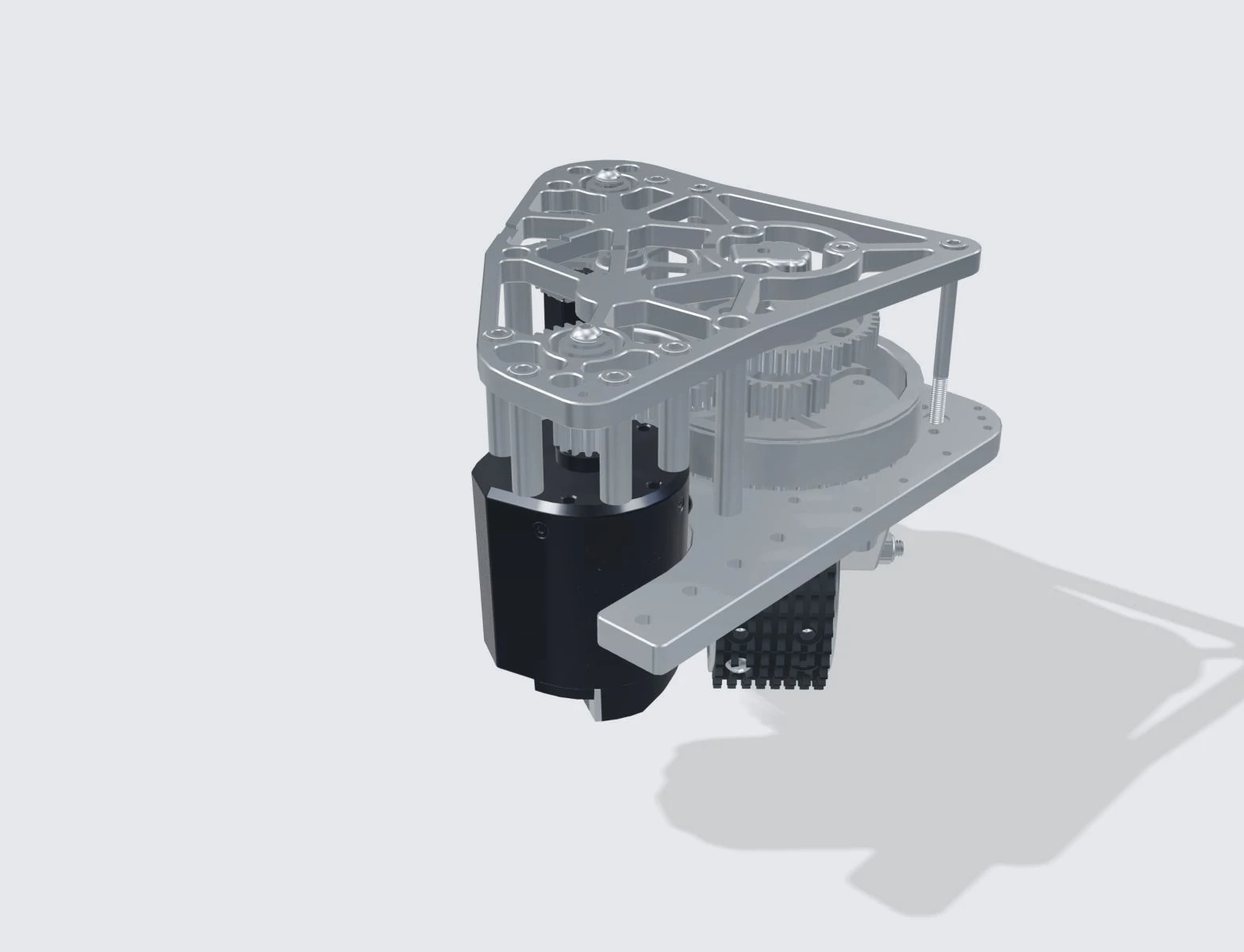
A swerve drivetrain uses four modules, each with a drive motor and a steering motor. Software calculates the wheel speeds and angles needed for the requested movement. This allows the robot to travel in one direction while facing another.
The March manual specifies 4-inch MK5R modules, Kraken X60 drive motors and Kraken X44 steering motors. Drive reduction is 6.75:1 and steering reduction is 24:1. The stated maximum speed of 4.58 m/s is a design specification, not a measured test result.
Measuring movement
A CANCoder measures each module’s absolute steering angle. Software combines wheel travel, steering angle and gyro heading to estimate the robot’s movement. This process is called odometry.
Measurements need matching timestamps. A steering angle measured before a turn should not be combined with wheel travel measured after it as though they happened together.
Model revision
The supplied September standalone module is labelled Swerve-MK2r. The March manual describes MK5R. They are different sources and should not be treated as identical hardware.
Use the online 3D viewer to inspect the wheel and steering assembly. Use the manual for the specifications of the March design.